Racism is still around because it is prevalent in every generation. There are many attempts to lower the amount of racism, but starting at the main source of the problem could be an answer. It all starts with the children, since they are the only ones who have a fresh mind without biases implanted in them. Despite such a seemingly clear answer, children continue to grow up having racial biases and attitudes.
Question: Where are children getting their racial bias from?
Source: "Children Are Not Colorblind: How Young Children Learn Race" This article was written by Dr. Erin Winkler of the University of Milwaukee where she teaches courses on the racial socialization of children, the psychology of racism, and representations of race in U.S. popular culture. She has backed up her studies with numerous cited experiments and sources as well.
Thesis: Children get their racial bias from their daily surroundings, media, psychological inferences, and their parents restraint from discussing race with them.
According to Dr. Erin N. Winkler, it is a common mistake to claim all racial views children have are received from their parents. She explains how when young children express some sort of racial view or bias, parents just dismiss it by saying things like, “She doesn’t know what she’s saying.” Parents similarly avoid discussing race with their children all together in an effort to “not put ideas into their heads.” Winkler argues that this method is all wrong since by ages 3 to 5, children have developed racial attitudes that do not necessarily resemble their parents. Children are getting their racial biases from other sources and the fact that parents fail to slow down these biases only helps them grow.
 |
| Source |
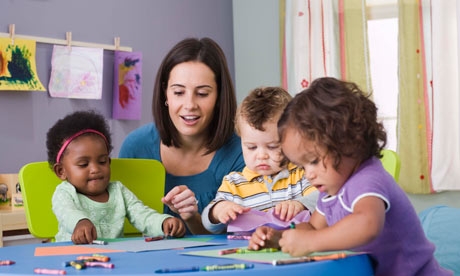
Beginning at very young ages, children are not always surrounded by their parents. Many could say a toddler’s first socialization is at the daycare he or she visits. A study performed by Van Ausdale and Feagin in 2001 showed how in a racially diverse daycare, 3 to 5-year-olds used “racial categories to identify themselves and others, to include or exclude children from activities, and to negotiate power in their own social/play networks.” It is not shocking toddlers are doing this seeing that infants are able to nonverbally categorize people by race and gender at six months of age. It makes sense that children are noticing and categorizing physical differences so early since babies are always interested in unfamiliar faces and objects. Winkler stated, “when they (children) see people who are alike in one dimension (e.g., skin color), they presume they are alike in other dimensions as well (e.g., abilities or intelligence).” I think this is interesting because even as adults, people keep this same prejudiced mindset. We think it makes sense in a child’s simple mind, but even as adults this ideology is kept.
Of course, children do not develop all bias on their own. The people that fill their surroundings contribute to their racial attitudes as well. Winkler added how parents are not the only factor in surroundings by bringing up the example of accents. When a British family moves to America and has a child, their child does not speak with a British accent like his or her parents. Another factor in a child’s life that could provide racial attitudes is media. Winkler used the example of childrens’ books. The color white usually symbolizes positive things like Snow White or Glenda the Good Witch, while the color black commonly stands for evil or the Wicked Witch. This allows children to “pick up on the ways in which whiteness is normalized and privileged in U.S. society.”
Although I have provided numerous ways in which children receive racial attitudes from sources other than their parents, I still do agree that parents are the main contributor to a child having racial biases. I agree with Winkler that when parent’s avoid discussing race with kids, their questions only go unasked. It makes kids think that racial biases are acceptable and not a big deal. Parent’s bland responses like, “Good people are not racist,” do not help either. This similarly reinforces the idea that a child will never be a racist, so he or she should just avoid thinking about the topic whatsoever. Winkler suggests caregivers provide “accurate information about race and racism, caregivers should focus on teaching children to think critically,” and not just focus on one aspect of a person.

No comments:
Post a Comment