Did you know that the city of Chicago is higher than it originally was?
In Mary Schons article, she informs us how the Chicago had started to rebuild itself and what the townspeople did to improve the city, to make it better than it was before it had burned down.
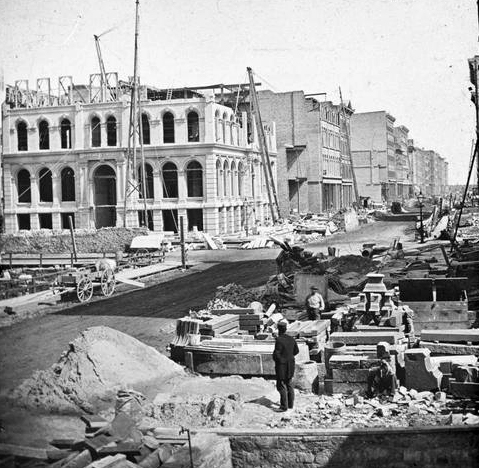 |
| SOURCE:http://chicagology.com/wp-content/themes/revolution-20/postfire/lakelasalle1873.jpg Rebuilding of a new Chicago |
1)The fire destroyed the city’s business district, but it left the stockyards and the new packing plants on the South Side untouched. Known as the “Hog Butcher of the World,” Chicago’s stockyards processed more meat than anywhere else on Earth.
A) I find this interesting because the city had been exporting meat all the time, since they were the city that had been bringing meat to other cities and towns. Because the fire had not reached the meat packaging area, they had been able to still do their work. Most people that had houses in the city wouldn't work with the conditions given. That being said, towns that were dependent on Chicago and if they weren't getting their meat, they might get concerned and see what was happening. Along with the meat center not being hurt, many railroads, wharf, lumberyards and mills were not damaged. So, not every part of the city had been ruined.
2)Two events stopped this phase of reconstruction. The first was the failure of a bank, Jay Cooke and Company, in September 1873. The bank’s failure triggered a nationwide depression that halted much of the Chicago construction. The second event was another, somewhat smaller fire, in July 1874. This fire destroyed more than 800 buildings over 60 acres.
A) What was interesting was that Chicago had made a law about what materials they needed to use before to build houses before the fire had started. It was that they had to use fireproof stone, and not wood, which was highly flammable. People disregarded the law, and built houses out of wood. When the fire started, the majority of the buildings that had been built with wood had been destroyed. After the fire, the city had started to rebuild. They got help from other towns and cities, which sent fireproof materials to build with. They also sent Terra-cotta, which was a clay that was a popular and effective material. The continuation of the city took a long and slow process.
3)The construction of the Home Insurance Building is a good example of how the Chicago School architects worked with businesses to form a new style. When the New York Home Insurance Company relocated its business to Chicago, they challenged the architectural community to come up with a design to bring natural light to all parts of the building. William Le Baron Jenney came up with a solution: Steel, lighter and stronger than iron, could be used on the upper floors.
A) This is interesting because when the city rebuilt one building, it inspired other architects about what the new buildings being built should look like. They also took into consideration of what they could do to make the buildings stronger, meaning they were going to have to use steel, which was much more effective and easier to use in building. While rebuilding the city, they ended up raising the city up a few feet, and built over the ruins of the burned city also.Discussion question: What could the city do better to have improved the city as they were rebuilding?
Further Research: What did the government do to make a better Chicago?

No comments:
Post a Comment